
Delhi delight!

Share
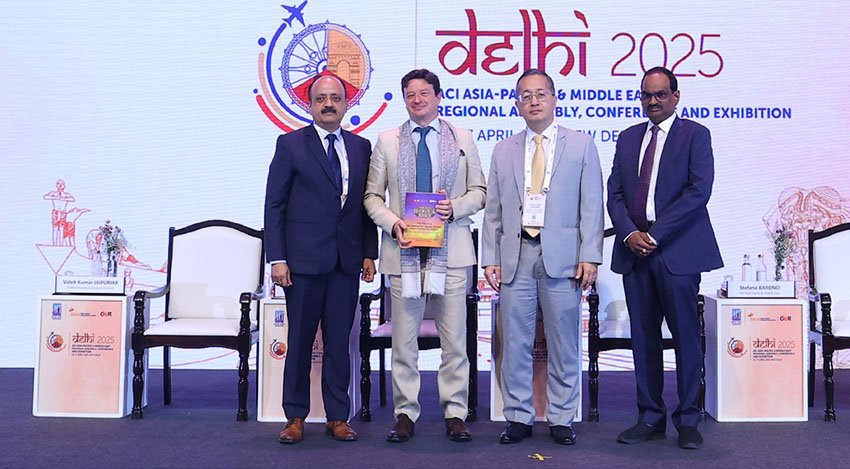
We look back at some of conference sessions, key announcements and award ceremonies held during April’s ACI Asia-Pacific & Middle East Regional Assembly, Exhibition and Conference in New Delhi.
The New Delhi setting for this year’s ACI Asia-Pacific & Middle East Regional Assembly, Exhibition and Conference almost guaranteed that it would provide a rich tapestry of culture, collaboration and strategic dialogue, and it didn’t disappoint.
Indeed, more than 400 delegates and 20 exhibitors ensured that this year’s event was a lively, colourful and entertaining affair from opening until close.
In his opening address, ACI APAC & MID president, SGK Kishore, reaffirmed the region’s unwavering commitment to air connectivity, sustainability, and innovation. He underscored the importance of maintaining the industry’s momentum, even amidst global uncertainties.
While Videh Jaipuriar, CEO of event host Delhi International Airport Ltd, shared the meaning behind the event logo – an emblem inspired by India’s rich diversity and vibrant culture, symbolising unity across the aviation sector.
Vumlunmang Vualnam, India’s then Secretary of the Ministry of Civil Aviation, highlighted India’s aviation growth as a symbol of transformation and opportunity, encouraging industry stakeholders to place the passenger experience at the heart of airport operations.
He also recognised the remarkable growth of aviation in Asia-Pacific and noted that elevating the passenger experience had to be a top priority.
As always at the event, ACI Asia-Pacific & Middle East’s director general, Stefano Baronci, delivered the State of the Industry speech.
Drawing inspiration from history, he reflected on how India once served as a vital hub on the ancient Golden Road, where ideas, culture, and trade flourished well before the Silk Road. As the region continues to emerge as a global aviation powerhouse, he pondered whether today’s air connectivity could rekindle that spirit.
He mused: “Can modern air connectivity revive that ancient spirit of exchange and influence?” The numbers, he stated, point to a transformative shift towards air travel, with Asian airports alone expected to be welcoming 9.6 billion passengers annually by 2053 – equal to total global traffic today. Also by then, it is predicted that seven out of the top 10 aviation markets will be in Asia and the Middle East.
He revealed that that airports across Asia-Pacific and the Middle East will be investing more than $240 billion on airport infrastructure in the next 10 years, while cargo volumes are set to nearly double, driven by e-commerce and shifting global trade routes.
“But growth won’t come easily,” he noted. “We need to fix infrastructure gaps, improve air traffic flow, speed up aircraft deliveries, and push for policy reforms.”
The DG urged the industry to come together to build a connected, resilient, and sustainable aviation ecosystem that reflects the ambitions of the Asia-Pacific and Middle East region and meets the needs of future generations.
Day 1 of the conference featured a much-anticipated keynote interview with Paul Griffiths, CEO of Dubai Airports. The veteran aviation leader emphasised the robust aviation ties between the UAE and India and encouraged Indian airports to draw on Dubai’s lessons in building global hubs.
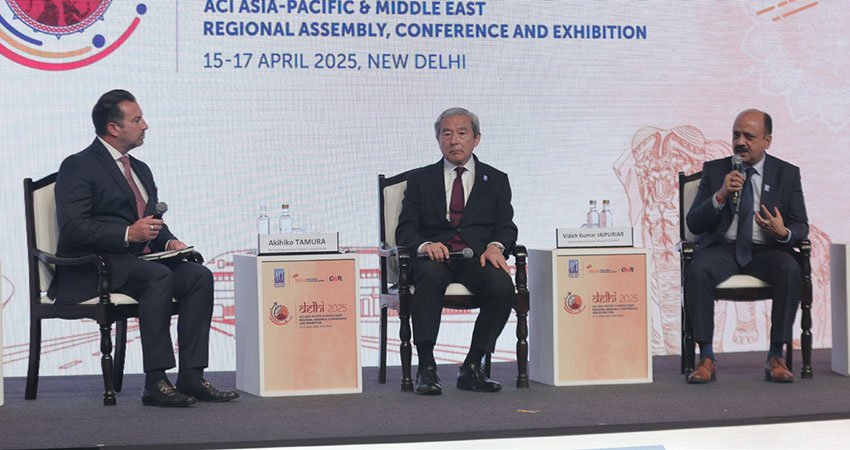
In the Leaders’ Dialogue session, Akihiko Tamura, CEO of Narita International Airport Corporation shared how working closely with different stakeholders and sharing data can help airports use technology better and improve operations. In essence, he advocated for deeper collaboration and transparent data sharing to optimise tech-driven operations.
Delegates also heard from Abd Hasman Abd Muhimin, general manager for operations at Malaysia Airports Holdings Berhad; Captain Digvijay Singh, chief pilot B777 and VP for flight operations at Air India; Takata Hiroyuki, regional officer for air traffic management at ICAO; and Poh Theen Soh, director of Asia Pacific affairs for CANSO; and Jan Friedrich, regional manager Asia-Pacific for airsight GmbH on how air traffic systems are evolving.
More specifically, they noted that focusing on Air Traffic Flow Management (ATFM) and Airport Collaborative Decision-Making (A-CDM) approaches would help aviation deal with the anticipated increase in traffic in a smarter, more co-ordinated way.
Day 2 of the event began on a high note with the World Business Partners Breakfast, a dynamic gathering of industry leaders, including top airport CEOs and valued members of the World Business Partner (WBP) community.
Indeed, for many it was a unique opportunity to engage directly with airport executives and gain meaningful insights into their strategic priorities over the next five years – ranging from infrastructure development and passenger experience enhancements to upcoming business and tender opportunities.
Key speakers included Mesake Seavula, CEO of Fiji Airports; Ali Masrahi, CEO of Cluster2; Mohamed Yousif Al-Binfalah, CEO of Bahrain Airport Company; and Videh Jaipuriar, CEO, of DEL operator DIAL.
The always popular gathering – which can spark candid conversations between airport leaders and industry business partners – was expertly moderated by Andrew Perrier, group business development director of the Almusbah Group and chair of WBP Advisory Board to ACI World (representative of ACI Asia-Pacific & Middle East).
Later sessions during Day 2 of the conference delved into climate adaptation, non-aeronautical revenues, and digital transformation, highlighting a shift toward data-driven, passenger-centric, and environmentally sustainable airport models.
During the ‘Climate Adaptation Approach for APAC & MID Airports’ panel, delegates were treated to different strategies for building climate-resilient airports and shared progress updates on ACI Asia-Pacific & Middle East’s ongoing adaptation initiatives across the region.
In another session on the non-aeronautical business, top executives from airports, retailers, and associations provided sharp insights into shifting travel patterns, evolving spending behaviours, and how technology and sustainability are shaping the next generation of airport experiences.
Delegates also had the opportunity to listen to an intriguing debate about how digital innovation is diversifying commercial offerings at airports and delivering frictionless journeys for passengers.
MAJOR INVESTMENT IN INFRASTRUCTURE
The size of the infrastructure investment challenge facing the region’s airports was outlined by a new ACI APAC & MID study that reveals that airports in the Asia-Pacific and Middle East regions are poised to undergo extensive development, with combined investments of $240 billion between 2025 and 2035.
ACI APAC & MID conducted a comprehensive survey, comprising over 30 key airports from the region to assess their airport development needs. The findings indicate a strategic focus on both the modernisation of existing airports and development of new airport infrastructure.
You can read more about then association’s findings and some of the biggest projects taking place across Asia-Pacific and the Middle East on pages 28-33 of this issue.
YOUNG EXECUTIVE AWARD
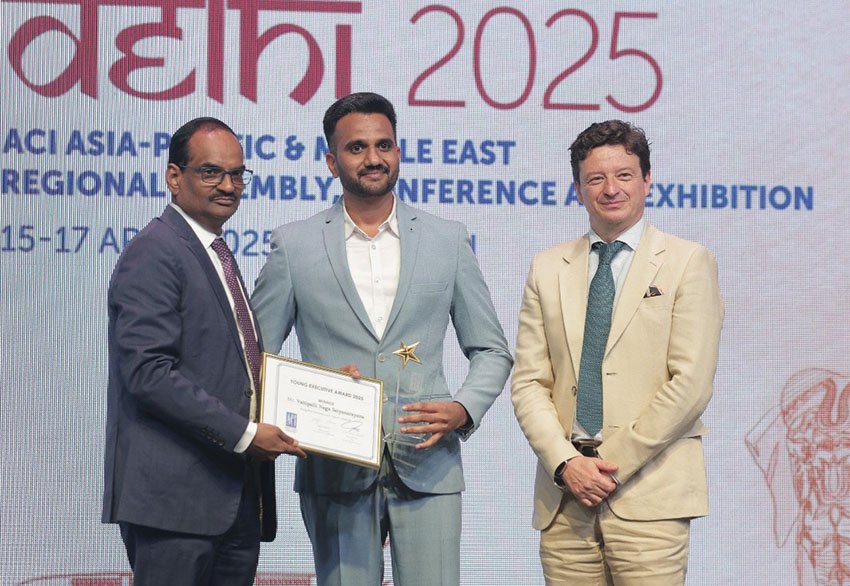
During the conference, Naga Satyanarayana Vattipalli of Kempegowda International Airport operator, BIAL, was named as the winner of the ACI Asia-Pacific & Middle East’s Young Executive Award for 2025.
The topic of this year’s programme was ‘How Artificial Intelligence will Transform Airports and Customer Experience’.
In his award-winning paper, Vattipalli explored the opportunities and challenges associated with airports adopting artificial intelligence and related technologies to improve the overall passenger experience and regulatory and ethical considerations, sustainability, and environmental impact.
Stefano Baronci said: “We congratulate Mr Vattipalli for this recognition. With the advent of rapid development of technologies, AI is being applied to provide innovation throughout the entire airport experience.
“The exceptional research paper bring us new visions into the role of AI in aviation and its potential in enhancing airport operations and the passenger experience at large.”
The panel of judges also awarded an honourable mention for Patrick Su from Airport Authority Hong Kong for his research paper entitled ‘Revolutionising Aviation: The Impact of Artificial Intelligence on Airports and Passenger Experience’. His research paper examined the impact of AI on airports and customer experiences.
This year’s panel of judges comprised Ayman Abdulaziz AboAbah, CEO of Riyadh Airports Company; Carrie Hurihanganui, chief executive of Auckland Airport; Tine Haas, director for airports and aviation at Dornier Consulting International GmbH; Dr Manjit Singh, deputy regional director at ICAO’s Asia and Pacific (APAC) Office; and Stefano Baronci.
AERODROME SAFETY CHAMPIONS
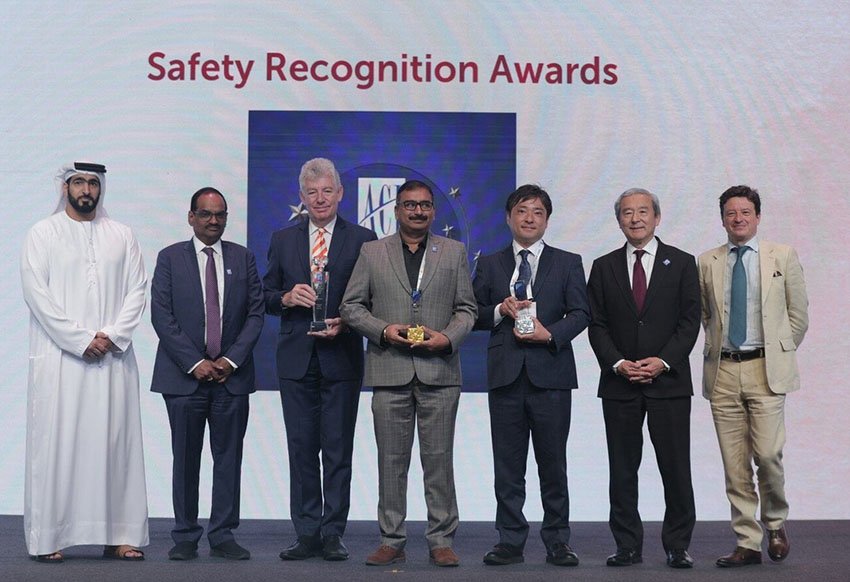
ACI Asia-Pacific & Middle East honoured three airports for their outstanding commitment to aerodrome safety with the presentation of its inaugural Safety Recognition Awards 2025.
Dubai International (DXB) in the UAE, Bengaluru-Kempegowda (BLR) in India and Japan’s Tokyo-Narita (NRT) were recognised for their exemplary safety cultures and innovative approaches to promoting aerodrome safety.
The awards were based on submissions detailing successful safety initiatives, with winners selected by a distinguished panel of judges comprising the regional directors of ICAO APAC Office, ICAO MID Office, and ACI Asia-Pacific & Middle East.
Good all-rounder DXB received the top Diamond Award, BLR the Gold Award and NRT the Silver Award in the Safety Recognition Awards.
The winners were selected from a pool of submissions from airports from across Asia-Pacific and Middle East.

Baronci noted: “Safety is the number one priority. The selected airports, carefully scrutinised by ICAO have been awarded for their innovative solutions and represent best practices for other airports to follow.
“We congratulate the winners and commend all participating airports for their commitment to aviation safety.”
A RESOLUTION FOR THE FUTURE
At the close of the Assembly, airport members passed a powerful resolution to:
- Promote infrastructure optimisation and expansion
- Enhance air traffic flow and collaborative decision-making
- Encourage public-private investment models
- Embrace sustainability, innovation, and digitisation
- Support lighter regulatory oversight and regional co-operation.
This resolution sends a clear signal – the airports of Asia-Pacific and the Middle East are prepared to lead the aviation industry into a more connected, efficient, and sustainable future.

DONATION FOR MYANMAR EARTHQUAKE RELIEF FUND
An uplifting announcement made during the event was the fact that ACI APAC & MID has contributed $50,000 to Airlink, a disaster logistics non-profit organisation, to support humanitarian relief efforts in Myanmar following the recent devastating earthquake.
In addition, ACI APAC & MID has launched a campaign amongst its members in aid of the relief efforts in Myanmar. The funds raised from the initiative will enable Airlink to facilitate the rapid delivery of essential aid and responders to the affected regions in Myanmar, providing crucial support to communities grappling with the aftermath of the earthquake.
ACI Asia-Pacific & Middle East president, SGK Kishore, said: “The devastation caused by the recent earthquake in Myanmar is truly heart-wrenching, and as an industry that connects people and communities, we believe it is our responsibility to stand in solidarity during times of crisis.
“This contribution of $50,000 by ACI APAC & MID will hopefully incentivise broader support across our network.
I urge all our member airports and industry partners to step forward and contribute to this critical humanitarian cause. Together, we can make a meaningful difference in the lives of those affected.”